
We Can Be Better
Directionally Correct Newsletter, The #1 People Analytics Substack


By: Tyler Weeks & Cole Napper
Cold Open
On the most recent episode of the Directionally Correct podcast, Tyler made the provocative statement to Cole:
“If you were a PhD student getting ready to graduate and you asked me where I thought you could make the biggest impact on the world, I’d tell you HR.”
Anyone in their right mind might ask, if I want to make the biggest impact on the world, why not focus on fusion or colonizing Mars or world hunger or whatever?
Simultaneously they would imagine Toby from The Office and plead, “HR… Really?”
Yes. Really.
But we must be better.
As the scale of human endeavor grows, the most important problems we can work on as a society is how to execute those projects, such as space exploration. Fun Fact: It took about 400,000 people to put 12 people on the moon, with the cost equivalent to almost 5% of GDP of the U.S. at the time. 400,000 people and it was just enough to make a few visits, take a look around, grab some souvenirs, and come home.
If we have the will to go beyond the moon, expanding into the solar system is incomprehensibly more complex. To solve a problem like that will require millions, if not billions, of people working in coordination with every robot and bit of AI we can scrounge up, and that still might not be enough. We would have a human coordination problem an order of magnitude higher than we’ve ever seen. It would be an HR nightmare to coordinate, and we must do better.
The Shoulders of Giants
Decades ago, I-O psychologists and other behavior science disciplines pulled Human Resources out of the stone ages, imbuing the function with evidence-based methods for building and managing effective organizations. They brought rigor, validity, and structure to a “gut feel” world. Later, data science extended the application of those mid-century psychometric techniques well beyond what anyone could have imagined possible. These pioneers set the stage for the organizational revolution ahead of us and are the giants upon whose shoulders we currently stand.
We must not stand on those shoulders only to look at our feet.
The HR technology ecosystem is woefully uninspiring. Our current vision of highly productive organizations seems to be narrowly focused on collecting and tracking people and their skills as interchangeable units. We build tools for Talent Management, Position Management, Headcount Management, Succession Planning, Workforce Planning, Applicant Tracking, and we hire smart people to think of ways to make those tools more efficient. So far, the introduction of LLMs has only inspired developers to double down on making those same tools more efficient.
We are stuck imagining what we can do with “faster horses,” tinkering with the same tools we’ve had since the internet was born. We seem to have accepted the limited degrees of freedom those tools provided and are satisfied tinkering with the margins.
If we’re going to exit the “faster horses” phase of this revolution, we’re going to have to discover new degrees of freedom. The disciplines that have driven innovation up until now are too stuck in their current orthodoxies. We need a new research and development pipeline fueled by a new type of scientist and a new type of engineer.
Paradigm shifts
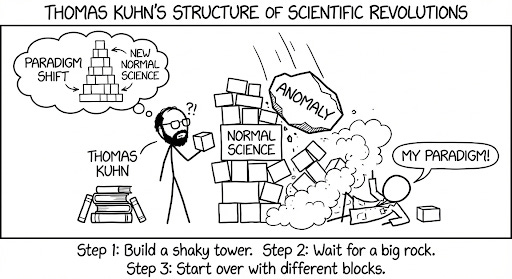
So, where do we find these new scientists and engineers? We look at how other sciences solved their own stalemates. Thomas Kuhn’s famous “Structure of Scientific Revolutions” states that scientific advancement occurs when the dominant paradigm fails to explain the anomalies in the world. As the current scientific understanding fails to address real problems, a crisis ensues, followed by a shift to a new paradigm of thinking. We’ve been here before.
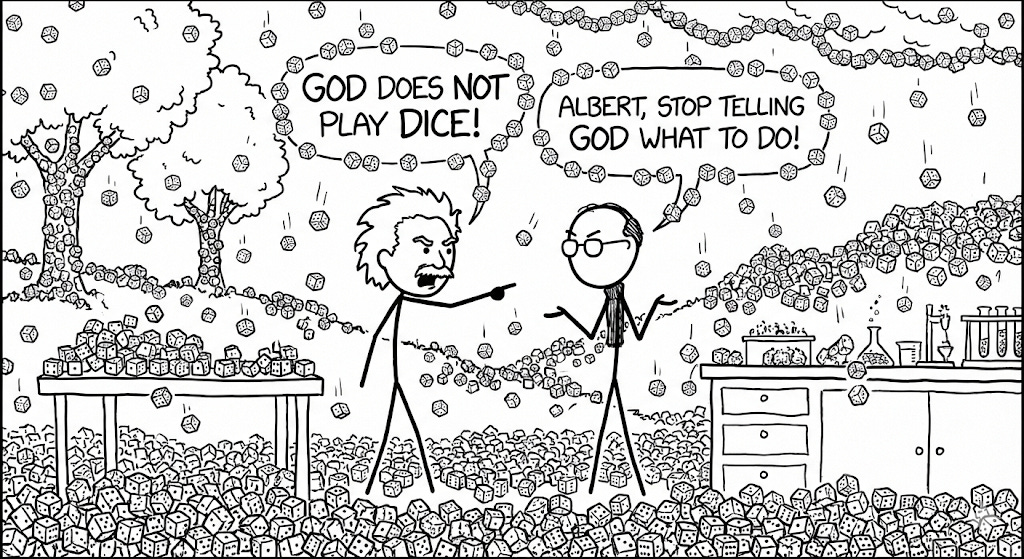
A hundred years ago, the Physics community was at war with itself. General relativity described the mind-bending interactions between light, gravity, and time, capturing the imaginations of the world and making Albert Einstein the most famous scientist ever. Meanwhile, breakthroughs were also being made at the impossibly small quantum scale by Niels Bohr. Einstein refused to believe quantum physics and famously pitted himself against Bohr in what became one of the great professional rivalries of the era.
Einstein was wrong, of course. And the funny thing about his error is that his work on quantum mechanics, the photoelectric effect, ultimately won him a Nobel Prize. Einstein was famously brilliant, but being smart sometimes can’t save you from yourself.
Every field needs a Bohr-Einstein rivalry. Every field has axioms of “ground truth” that are wrong. People analytics is no different.
Our current understanding of organizations has been limited by what we could measure. We have a robust picture at the macro level, relying on the central limit theorem and frequentist statistics to identify and validate foundational principles of organizational dynamics. After 100 years of trying to drive productive organizations at scale, our axioms have yet to produce technology that couldn’t be replicated by a room full of people with spreadsheets.
Now is the time for a paradigm shift. We need to recruit more physicists, engineers, biologists, ecologists, economists, and all the other “-ists” that are unencumbered with the past and collaborate to pave a new future. These new entrants will not be qualified to do this work at first, just look at how much of a disaster Tyler was when he first joined HR (😁). Other disciplines have no idea how complex and nuanced HR problems are, but that’s precisely why they will be so valuable. Unencumbered minds can bring unorthodox ideas that will unlock new degrees of freedom and new possibilities for impact.
AI as a Telescope
LLMs have precipitated a moment of profound expansion. Watershed moments like this are always uncomfortable. People wanted “faster horses”, remember?
One way we start to embrace this moment is to recognize the enterprise LLM as a new kind of measurement tool. The dominant narrative of HR use cases for LLMs has been too narrowly focused on automation and efficiency. This focus is constraining our thinking.
HR has relied on surveys, assessments, and performance ratings for decades, largely because they were the best tool, only tool, or most legally defensible tool we had available. Yet, we’ve all thought: “There has to be a better way”.
Despite all the value these innovations brought to HR at the time, there’s nothing more HR scientists are going to get out of Likert scales. We have a new measurement instrument, and we don’t know the limits of what it can do. We should be covering new ground. Paradigm shifts are afoot. Applying AI to our current methods would be like using the James Webb Telescope solely to read street signs. We need to point it at the stars.
The best place we can start is to challenge our teams to write down all the things they wish they knew about the organization and all the craziest things they’ve ever wanted to try. Then we take those lists and experiment on how we might use these new tools to make objective measurements. No Likert scales allowed.
A New Partnership
If you take the challenge above seriously, you’re going to get some truly wild, crazy, and even ethically fraught ideas. Some of those ideas might be interesting but too risky to try in the wild on first pass. For those truly wild ideas, we need a renewed partnership between industry, academia, and government.
In medicine, you don’t jump straight to human trials. You start with the mouse studies. You test high-risk, volatile hypotheses in the lab where failure is data, not a disaster. These labs are where the moon shots happen.
We need academic partners to challenge our dogmas, not reinforce them. I can imagine our “mice” might be agent-based models of 500,000 digital employees, used for testing the effects of incentive pressure of new compensation structures over long periods of time, while never impacting a real person’s paycheck.
When those experiments yield results and have been tested and checked and validated, then industry leaders must be ready to act. We must be the clinicians who take those successful “mouse studies” and apply them in limited trials in the real world, scaling as we learn and refine. Those successes and failures must be shared with the broader community. Yes, there is a competitive advantage to doing something better than the next company, but if an idea truly works, other organizations will be incentivized to copy them. Can you imagine living in a world where precisely one company has substantively re-invented their workforce? How long could it last?
Just Try It
People analytics is not a finished product. It is being disrupted before our eyes. We all see it. Here’s the opportunity, though: People analytics is the predecessor of what needs to come next. We are the people that are going to build that new thing. But only if we step up. We must do better.
The future will be built by optimists.
We can meet the challenges of this moment and manage complexity at the scale required for true human expansion. We can power organizations of the future. We can tackle the problems of human coordination at scale. All we need is the will, and the experimental mindset to make it happen. This will require a new partnership between industry, academia, and government. It means trading small, incremental gains on the old paradigm for radical, collaborative discovery in the new world. It means pointing our AI ‘telescopes’ at a future far beyond the office walls.
We can build the workforce humanity needs tomorrow, today.
I hope you like this article. If so, I have a few more articles coming out soon. Stay tuned. If you are interested in learning more directly from me, please connect with me on LinkedIn.
Cole’s recent articles
For access to all of Cole’s previous articles, go here.
 | A guest post by
|
Love it! I was just asking Gemini yesterday who else is writing and thinking about using LLMs for assessments.